This post contains affiliate links. As an Amazon Associate we earn from qualifying purchases. Our picks are based on Amazon bestseller rankings, Amazon customer ratings, and product availability. We update our recommendations regularly to ensure accuracy.
Upgrading your car's audio system can significantly enhance your driving experience. Component speakers, known for their superior sound separation and clarity, are a popular choice for audiophiles. Investing in the right set ensures you get the most immersive and enjoyable sound quality on every journey.
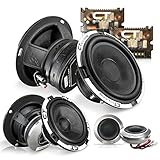
Echo Series 6.5” Component Speaker System. Peak Power - 200 Watts (Pair) | RMS Power - 100 Watts (Pair)
Lightweight thermal-formed Polypropylene cones enable faster midrange response. Surround/Cone Coupling utilizes a high temp adhesive which assure the cone and surround do not separate in high power uses. Butyl rubber surrounds provide durability and...
Silk soft-dome tweeters feature oversized voice coils for greater heat dissipation and higher power handling resulting in smooth, fatigue free highs. The mount allows unparalleled flexibility whether you flush or surface-mount your tweeters
A triple-level tweeter volume adjustment helps compensate for less-than-perfect speaker placement, and can even be set to suit your personal listening preference and musical taste
Plus One Woofer Cone Architecture: Patented (US patent #7,548,631) Plus One cones provide more overall speaker-cone area than other speakers of the same size, resulting in higher sensitivity, increased low-frequency output and greater musical character.
Adjustable Tweeter Output Level: The Club 64 and Club 64C, Club 64CTP component systems offer a tweeter output level control of 0dB or +3dB to optimize system linearity based on installation location.
Acoustically Damped, UV-resistant Polypropylene Cone: Every Club speaker's woofer cone is designed to deliver clean, non-resonant sound quality, while standing up to the demanding heat and humidity of the car environment.
Bigger Magnet, Bigger Power Handling: The new Club lineup features a larger magnet delivering higher power handling than competitors at similar price points.
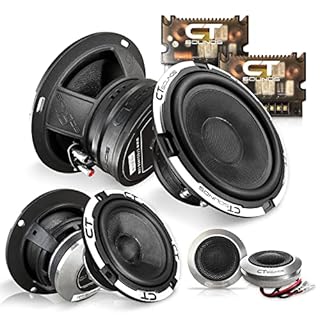
Speaker size: 6.5” 3-way component speaker set, Impedance per speaker: 4 Ohm, Power per set: 250W RMS | 500W MAX
If you want to play your music loud enough for the entire neighborhood here, the CT Sounds Meso 3-Way component speaker set will do just that, and then some
Take your sound to the next level, the meso 6.5 inch component speakers can be turned up uncontrollably loud with no distortion
Included 3.5” midrange speakers feature a neodymium motor assembly and will have your music heard from several blocks away
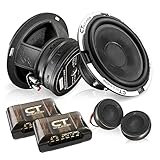
Speaker Size: 6.5” 2-way component speaker set, Impedance per speaker: 4 Ohm, Power per set: 160W RMS | 320W MAX
Custom engineered 6.5 inch component speakers built to bring you the highest tonal accuracy by providing a well-balanced of powerful mid-bass and snappy highs
Take your sound to the next level, the meso 6.5 inch component speakers can be turned up uncontrollably loud with no distortion
Included 25mm silk-dome tweeters are suspended in ferrofluid with a N38H motor assembly to provide an accurate reproduction of your favorite tracks
MIDRANGE THAT HANDLES IT ALL - A mid-range driver that can answer the call to handle the most significant part of the audible sound spectrum. A speaker that sounds great with just instrumentals and, even better with vocals
POWER YOU CAN COUNT ON - The PRO-GM6. 4 delivers an impressive 480W Max Power with 140W RMS at 4 Ohms, enough to tackle a full range of audio
TOP OF THE LINE TWEETERS - Professional grade super tweeters that can handle high frequencies with ease. DS18 meticulously designed these tweeters to sound as good as they look.
POWER YOU CAN COUNT ON - PRO-TW120 ferrite tweeter delivers out-of-this-world power, at 200 watts RMS and 300 watts Max at 4 ohms with build in capacitor filter.
The Prime R152-S is a 5.25” 2-way component system rated at 40 watts RMS / 80 watts peak, for a new generation of factory replacement speakers
The R152-S kit includes two 5.25” woofers with grilles, and two 1” tweeters with integrated crossovers and mounting hardware
Delivering authentic Rockford sound by utilizing a Mica injected polypropylene cone for extended frequency response and accommodates direct OEM installation
The tweeter features a Mylar¨ balanced dome to reproduce crystal clear highs, an in-line crossover for simplifying installation, and accommodates flush, surface and angle mounting
Last update on 2026-11-24 / Affiliate links / Images from Amazon Product Advertising API
How to Choose the Best Component Car Speakers
Understanding Component Speakers
Component speakers separate the woofer (for bass and mid-range) and the tweeter (for high frequencies) into distinct units. This separation allows for better sound staging and a more accurate audio reproduction compared to coaxial speakers, where all drivers are housed in a single unit. They typically require a separate crossover to manage which frequencies go to which speaker.
Key Specifications to Consider
Size: Common sizes include 5.25 inches, 6.5 inches, and 6x9 inches. Ensure the size fits your vehicle's existing speaker mounts.
Power Handling (RMS): This indicates how much continuous power the speakers can handle. Match this to your amplifier's output for optimal performance and to avoid damage.
Sensitivity: Measured in decibels (dB), sensitivity indicates how loud a speaker can play with a given amount of power. Higher sensitivity means they can be driven effectively by lower-powered head units or amplifiers.
Frequency Response: This shows the range of sound frequencies the speaker can reproduce. A wider range generally leads to richer, more detailed sound.
Installation and Compatibility
Installing component speakers often requires more effort than direct replacements due to the separate tweeter and crossover. You may need to drill new mounting holes, run new wires, or modify existing speaker grilles. Researching your vehicle's specific speaker locations and available space is crucial before purchasing. Many manufacturers provide vehicle-specific fitment guides online.
Crossovers and Amplification
Component systems come with crossovers, which are essential for directing the correct frequencies to the woofer and tweeter. Some crossovers are passive and easier to integrate, while others might offer adjustable settings for fine-tuning. For the best performance, consider an aftermarket amplifier, as most factory head units lack the power to drive component speakers to their full potential.
Frequently Asked Questions
What is the difference between component and coaxial speakers?
Component speakers have separate woofer and tweeter drivers, along with a crossover, allowing for precise sound imaging. Coaxial speakers integrate the woofer and tweeter into a single unit, offering a simpler installation but often compromising soundstage.
Do I need an amplifier for component speakers?
While some component speakers can be powered by a factory head unit, an aftermarket amplifier is highly recommended. Amplification provides the necessary power to drive the speakers effectively, resulting in clearer sound, better bass response, and higher volume levels without distortion.
What does RMS power handling mean?
RMS (Root Mean Square) power handling refers to the continuous amount of power a speaker can safely manage. It's a more reliable indicator of performance than peak power, which represents short bursts of power.
Can I install component speakers myself?
DIY installation is possible but can be more complex than replacing factory speakers. It often involves mounting tweeters separately, running wires, and potentially modifying door panels or grilles. If you're not comfortable with car electronics, professional installation is advisable.
How do I choose the right speaker size?
Check your vehicle's owner's manual or consult online fitment guides to determine the factory speaker sizes. Common replacements for factory speakers are 5.25-inch or 6.5-inch woofers, but adapter plates may be needed for certain vehicles.
As an Amazon Associate, we earn from qualifying purchases. Product prices and availability are accurate as of the date/time indicated and are subject to change.
Amazon pricing is not included in price tracking/graph. We do not issue alerts for any products through Amazon.