As an Amazon Associate, we earn from qualifying purchases. Check the exact model, current price and availability with the retailer before buying.
Start with the result the materials or optics team needs. A compact visible spectrometer can report light across a range of wavelengths. A UV-Vis bench instrument can support transmission or reflectance for suitable samples with the correct accessories. An FTIR spectrometer measures an infrared signature that can help compare a material with documented references. We compared the options using published documentation. See the sources.
Choose by use
- Ocean Optics Ocean ST-VISFor an optical bench that needs a compact module to characterize a visible light source or optical system.
- Agilent Cary 60 UV-Vis SpectrophotometerFor a bench that reports UV-Vis transmission or reflectance for a supported material sample.
- Thermo Scientific Nicolet Summit X FTIRFor materials QA that compares an infrared signature, such as a polymer incoming inspection.
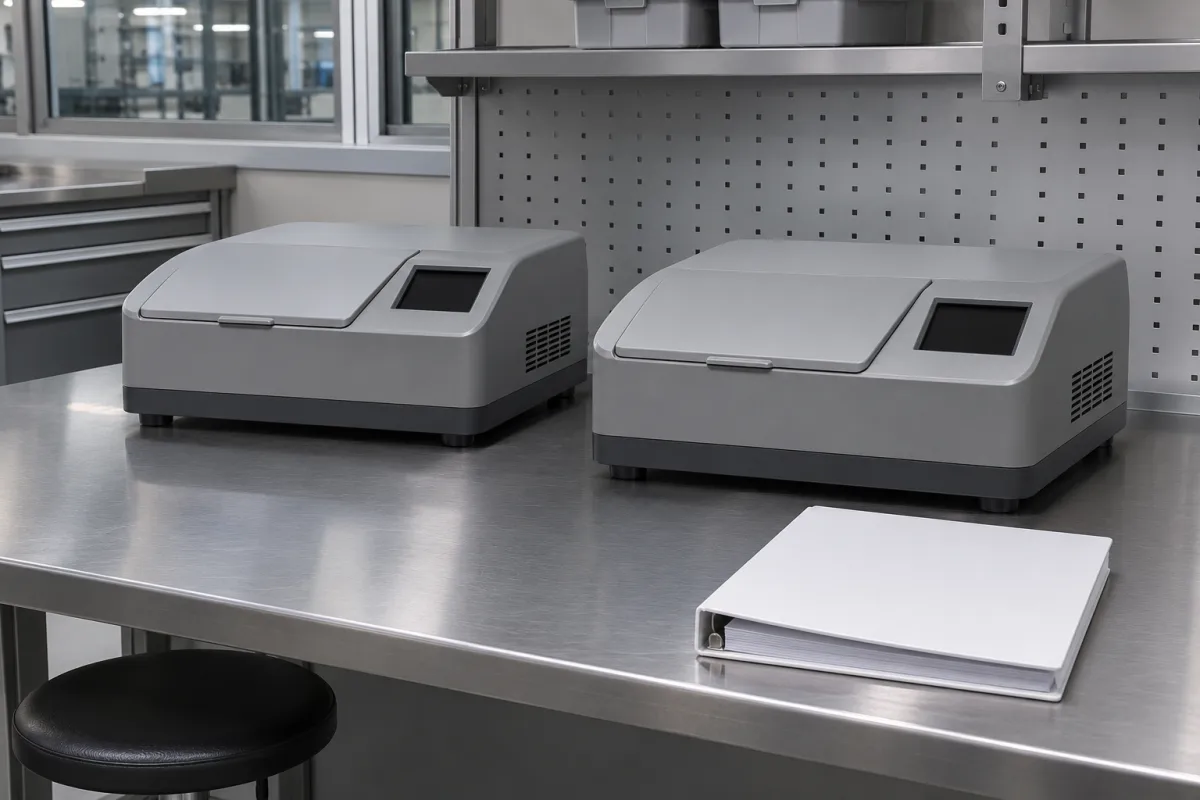
Compare the three options
Scroll horizontally to compare all columns.
| Ocean Optics Ocean ST-VIS | Agilent Cary 60 UV-Vis Spectrophotometer | Thermo Scientific Nicolet Summit X FTIR | |
|---|---|---|---|
| Optical result | Light spectrum for an optical bench | Transmission or reflectance for a supported sample | Infrared spectral signature of a material |
| Instrument form | Compact spectrometer module | Integrated UV-Vis bench system | Benchtop FTIR spectrometer |
| Main configuration check | Module variant and optical inputs | Sample holder and measurement geometry | Material accessory and reference-library coverage |
| Report to plan for | Spectral data and applicable reference information | Measured spectrum and documented sample geometry | Spectrum, material reference and comparison evidence |
| Manufacturer example | Ocean ST-VIS | Cary 60 | Summit X, 912A1139 |
Compare compatibility and trade-offs for your use. See sources and methodology
Options and trade-offs
Ocean Optics Ocean ST-VIS
For an optical bench that needs a compact module to characterize a visible light source or optical system.
Ocean Optics lists the ST-VIS for optical integration and LED characterization. Its product table specifies 350–810 nm wavelength coverage and variant-dependent optical resolution.
Keep in mind Verify the exact model and optical connection in the quote. Include the supporting optics, software and reference documentation that your bench needs.
Agilent Cary 60 UV-Vis Spectrophotometer
For a bench that reports UV-Vis transmission or reflectance for a supported material sample.
Agilent documents access to solid-sample transmission and reflectance accessories for the Cary 60. The product also lists its measurement range and workstation software.
Keep in mind Ask the supplier to confirm the sample holder and measurement geometry for the result you need. Include the appropriate accessory and software in the quote.
Agilent Cary 60 UV-Vis product page
Thermo Scientific Nicolet Summit X FTIR
For materials QA that compares an infrared signature, such as a polymer incoming inspection.
Thermo Fisher identifies the Summit X as catalog number 912A1139. It lists polymer and plastics work among the applications and offers compatible materials analysis accessories.
Keep in mind Check the accessory, software and reference-library coverage for your material. Ask what evidence the lab will retain alongside a material comparison.
Choose the spectral result before the hardware
A spectrum reports a response across wavelength or another spectral coordinate. Specify whether you want to characterize the output of a light source, assess what a material transmits or reflects, or compare a material's infrared signature. [1] [3] [4] [5] [6]
Different results need different optical arrangements. A compact spectrometer can be part of a visible-light bench. An integrated instrument and its specified accessory can give a defined measurement geometry for sample work. [1] [2] [3] [4] [5]
Check the sample and accessory in the quotation
For a transmission or reflectance job, describe the material's form and the physical region you need to measure. Ask the supplier to show which accessory supports that geometry. Agilent lists different accessories for solid-sample transmission and reflectance with the Cary 60. [3] [4] [5]
For incoming material comparison, ask whether the proposed infrared accessory and references cover the material family. Thermo Fisher lists support for polymer QA in its Summit documentation. Record which accessories and reference capabilities are included in the quote. [6] [7]
Plan calibration records and reviewable exports
Confirm what data and reference details your quality system needs to retain. A reusable report may require the spectrum itself and a record of the instrument and measurement geometry. NIST's spectrophotometry work describes reference and calibration context for optical measurements. [2] [4] [5]
Ask for representative spectral evidence and a sample report from the proposed configuration. Review whether the result answers the intended optical or materials decision and fits your acceptance criteria before purchasing. [1] [3] [4] [6] [7]
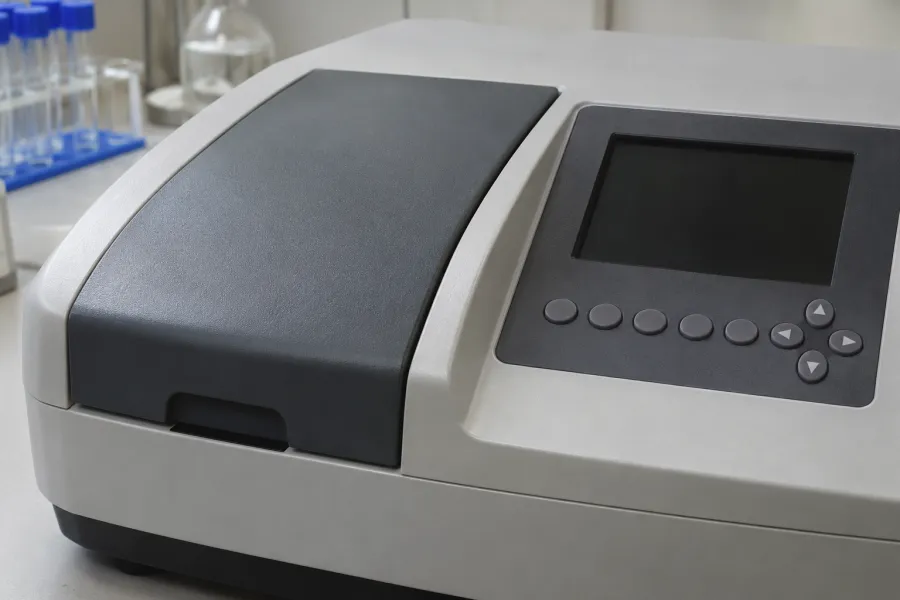
Common buying questions
Is a spectrometer the same instrument as a lux meter?
A spectrometer reports a spectral response. A lux meter reports illuminance in one photometric unit. Choose the measurement and report required by the work order. [1] [4] [8]
Which instrument should I choose for an optical transmission check?
Choose a supported transmission configuration with the matching sample holder and geometry. The Cary 60 is one documented UV-Vis option when its accessories fit the sample. [3] [4] [5]
What should I check when comparing FTIR for polymer QA?
Check whether the instrument, sample accessory and reference coverage match your materials and reporting workflow. Confirm those inclusions for the exact model on the quote. [6] [7]
Does the smallest spectrometer make the most portable measurement system?
Compare the complete instrument, including optical accessories, support hardware and data connection. The ST-VIS is a compact module designed for integration into a larger system. [1] [2]
Sources and methodology
We compared manufacturer configurations for materials and optical quality checks and the NIST measurement context. Confirm your sample, measurement geometry and evidence requirements. See how we compare products.
- Ocean Optics ST-VIS product specifications. Exact visible module, integration applications and variant-specific spectral specifications.
- Ocean Optics ST product sheet. ST family descriptions, compact form factor and module variants.
- Agilent Cary 60 UV-Vis product page. Instrument coverage and options for solid-sample transmission or reflectance.
- NIST spectrophotometry program. Optical measurement types, research and calibration context.
- NIST spectral reflectance and transmittance. Reference measurement context for defined material and optical properties.
- Thermo Scientific Nicolet Summit X product listing. Exact Summit X catalog number, materials applications and available accessories.
- Thermo Fisher Nicolet Summit FTIR family. Instrument family, materials analysis capabilities and model distinctions.
- NIST definition of lux. Identifies the reporting unit of illuminance.
This article is part of our complete guide Lab & Scientific Equipment — browse all our comparisons and buying guides.
Before you choose
Compare specifications for the exact model and variant. Consider the dimensions, compatibility and maintenance that matter to your use. Customer ratings and product listings are different from independent hands-on testing.