As an Amazon Associate, we earn from qualifying purchases. Check the exact model, current price and availability with the retailer before buying.
Choose a TV signal amplifier according to where reception suffers. A preamplifier can preserve a usable antenna signal through a long coax run. A distribution amplifier can help when good reception drops after the signal is split across rooms. A multi-input amplifier serves homes that receive local broadcasts on more than one antenna. We compared the options using published documentation. See the sources.
Choose by use
- Channel Master PreAmp 1 CM-7779HDOne passive TV antenna feeding a lossy coax run
- Channel Master TV Antenna Booster 4 CM-3424One OTA antenna serving up to four TV outlets
- Televes SmartKom 531983Combining OTA antennas receiving stations from different directions
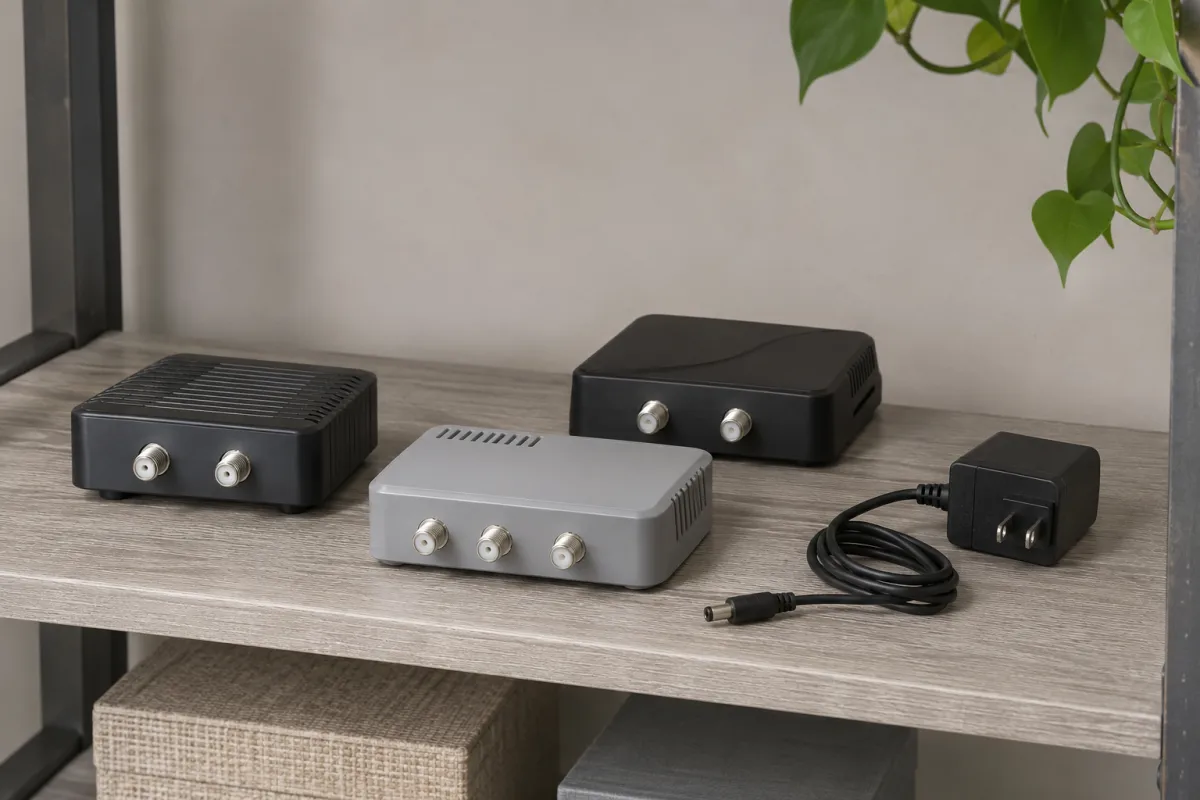
Compare the three options
Scroll horizontally to compare all columns.
| Channel Master PreAmp 1 CM-7779HD | Channel Master TV Antenna Booster 4 CM-3424 | Televes SmartKom 531983 | |
|---|---|---|---|
| Primary use | Preserve one antenna feed | Distribute one feed to four outlets | Combine up to three antenna feeds |
| Connections to compare | Single antenna feed and powered coax path | One antenna input and four amplified outputs | Three antenna inputs and one combined output |
| Amplification | Selectable 17 or 30 dB | Approx. 7.5 dB per output | Adjusts levels by channel |
| Ordering check | Passive antenna and power inserter | OTA antenna and number of TV outlets | Antenna count and separate downstream distribution |
Compare compatibility and trade-offs for your use. See sources and methodology
Options and trade-offs
Channel Master PreAmp 1 CM-7779HD
One passive TV antenna feeding a lossy coax run
The manufacturer specifies selectable gain of about 17 or 30 dB, a weatherproof housing, and a supplied power inserter for coax power.
Keep in mind Strong local signals can overload an amplifier or TV tuner. Count coax and splitter losses before buying for gain alone, and check for a compatible power path.
Channel Master TV Antenna Booster 4 CM-3424
One OTA antenna serving up to four TV outlets
The unit has four amplified outputs and a built-in filter for out-of-band signals. Channel Master describes approximately 7.5 dB of gain per port.
Keep in mind This model is specified for broadcast TV antennas. Householders shopping for cable or satellite service should use equipment approved for that service.
Televes SmartKom 531983
Combining OTA antennas receiving stations from different directions
The U.S. product page specifies three terrestrial antenna inputs, one combined output and individual channel filtering and level adjustment.
Keep in mind The unit combines feeds onto a shared coax line. Count the TVs and assess any separate distribution needs when you plan the purchase.
Look for the source of the dropout
Reception that is good on one TV but degrades when several outlets share the antenna points toward distribution loss. Problems on a short direct feed can come from antenna placement, coverage, a damaged coax cable, or a loose connector. An amplifier increases the signal level it receives and is most useful when the antenna already delivers a usable signal. [4] [5]
Keep signal level and signal quality separate. Channel Master notes that a stronger signal can overload a tuner and that amplification cannot correct severe interference or reflections. Check antenna reception and coax condition before deciding the system needs more gain. [4] [5]
Check compatibility at both ends of the coax
For a preamp powered over coax, follow the maker’s documentation on DC power and compatible splitters. For a distribution amp, count the outlets that need their own feed. For a multi-antenna combiner, check the inputs you need and what comes out of the device. The SmartKom combines those inputs into one output. [1] [2] [3]
Check the product page for the service and bands it supports. OTA reception uses a broadcast antenna, and the CM-3424 documentation limits it to that purpose. For a location with nearby strong stations, weigh the maker’s overload guidance before paying for a model with more gain. [2] [4] [5]
Common buying questions
Can an amplifier bring in a station the antenna cannot receive?
Amplification helps keep an existing usable signal through the coax and splitters. For a missing station, start by checking expected coverage and the antenna’s placement and frequency coverage. [4] [5]
What is the difference between a preamp and a distribution amplifier?
A preamp is intended for the beginning of the antenna feed before downstream cable losses. A distribution amplifier serves the branches that share a usable feed across several outlets. [1] [2] [4]
Do I need an amplifier for a short run to one TV?
If channels already come in steadily on a short coax run, there may be little loss to offset. Check for a concrete reception problem before adding gain. [4] [5]
Sources and methodology
We compared manufacturer documentation for over-the-air TV antenna amplification, distribution, and antenna combining. See how we compare products.
- Channel Master PreAmp 1. Lists the model, selectable gain, intended antenna pairing and included power equipment.
- Channel Master TV Antenna Booster 4. Describes the four outputs, filtering and OTA service restrictions.
- Televes SmartKom 531983. Identifies the three terrestrial inputs, combined output and channel level control.
- Channel Master amplifier selection guide. Explains cable and splitter loss, overload, gain per port and the roles of different TV amplifiers.
- Televes USA antenna reception FAQ. Explains what reception conditions call for a preamp or distribution amplifier.
This article is part of our complete guide Audio Equipment — browse all our comparisons and buying guides.
Before you choose
Compare specifications for the exact model and variant. Consider the dimensions, compatibility and maintenance that matter to your use. Customer ratings and product listings are different from independent hands-on testing.