Cookies and audience measurement
We use Google Analytics to measure how the site is used and to improve our content. It only loads with your consent: you can decline at no cost and change your mind at any time. Privacy policy
This post contains affiliate links. As an Amazon Associate we earn from qualifying purchases.
Our picks are based on Amazon bestseller rankings, Amazon customer ratings, and product availability. We update our recommendations regularly to ensure accuracy.
Selecting the right reflector telescope can significantly enhance your stargazing experience. A well-chosen instrument opens up the universe, revealing celestial wonders with clarity and detail. Investing time in understanding key features ensures you find a telescope that matches your observational goals and budget.
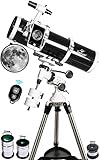
Reflector Telescope with Superior Optics: This reflector telescope features a 5.1 inch aperture and all-glass optical components with high transmission coatings that allow for enhanced image brightness and clarity, suitable for observing the Moon...
Toothless Focusing Base for Easy Operation: The telescope's short 24 inch long optical tube design and fast f/5 focal ratio, along with its toothless focusing base, provide a user-friendly experience for beginners and advanced astronomers alike
Complete Accessory Package: The included 3 eyepieces, a 3X Barlow lens, a finderscope, and an adjustable tripod make it easy to find and observe celestial objects from any viewing position
Wireless Remote Control for Convenient Photography: There is no need to download app, the remote can be paired with your device via Bluetooth, compatible with iPhone or Android device. With the bluetooth camera remote, you can take pictures or videos and...
130mm Newtonian Reflector: The 130mm aperture and 650mm focal length gather more light for bright views of the Moon, planets, and bright deep-sky objects.
Manual Equatorial Tracking: The EQ mount with slow-motion control cables helps you follow celestial objects as they move across the night sky.
Multiple Viewing Powers: Includes 25mm and 6.5mm eyepieces for 26x and 100x views. Use the 2x Barlow lens to double each eyepiece power.
Phone Adapter for Moon Photos: The included phone adapter and wireless remote make it easier to capture simple photos and videos through the eyepiece.
Large 150mm Aperture for Bright, Detailed Views: This high powered reflector telescope captures more light for brighter and sharper images. With a professional 150mm mirror and 650mm focal length, it reveals impressive lunar craters, nebulae, and galaxies...
Precision German Equatorial Mount: The EQ mount provides smooth tracking and accurate positioning of celestial objects. Featuring intuitive dials and dual slow-motion control cables, it allows precise manual adjustments. Preassembled for easy setup, most...
Clear Optics and Versatile Magnification: Includes 25mm and 10mm eyepieces plus a 2X Barlow lens, offering a flexible 26X–130X magnification range. Fully coated optics provide excellent light transmission and sharpness, while the moon filter helps...
Sturdy Tripod and Elegant Purple Design:The stainless steel tripod offers excellent stability and adjustable height for various users. Its unique purple finish combines sophistication with modern style—making the telescope not only high-performing but...
EXPERTLY MATCHED OPTICS: The Skymax series of Maksutov-Cassegrain optical tubes features matched primary and secondary mirrors with an expertly coated corrector plate that delivers contrast-rich views with charcoal-black skies.
94% REFLECTIVITY MIRROR COATINGS: Using a borosilicate primary mirror with an aluminum coating and a quartz overcoat, Sky-Watcher Maksutov-Cassegrains produce a 94% reflectivity rating for outstanding light transmission.
VIXEN-STYLE DOVETAIL: An industry standard, the Vixen-style dovetail is the most commonly used dovetail plate for astronomy. In addition to this, all Maksutov-Cassegrains come with a ¼-20 tripod thread under each dovetail bar, allowing users to mount to...
FULLY BAFFLED TUBE: Utilizing a fully-baffled tube, Sky-Watcher Maksutovs prevent stray light from interfering with your viewing experience.
SMARTPHONE-POWERED SKY TOUR: No experience needed! Just dock your phone, launch the StarSense Explorer app, and follow the on-screen arrows to locate stars, planets, nebulae, and more.
PATENTED STARSENSE TECHNOLOGY: Unlike other astronomy apps, StarSense Explorer uses sky recognition technology to turn your phone into a celestial navigation system, analyzing star patterns overhead to pinpoint your telescope’s position.
TONIGHT’S BEST TARGETS, INSTANTLY: The app generates a curated list of the top objects to see based on your time and location. See planets, bright nebulae, galaxies, and star clusters from the city—and even more from dark skies.
SIMPLE SETUP, SMOOTH TRACKING: Features a manual altazimuth tabletop Dobsonian-style base. Follow the on-screen arrows to your target; when the bullseye turns green, you can view it clearly through the eyepiece.
FAST f/4 OPTICS: With a bright f/4 focal ratio, the Quattro Imaging Newtonian captures greater detail in a shorter exposure time
2-INCH DUAL-SPEED CRAYFORD-STYLE FOCUSER: Never miss focus with this 2-inch dual- speed crayford style focuser
OVERSIZED SECONDARY MIRROR: All Quattro Newtonians use an oversized secondary mirror capable of illuminating both APS-C and full-frame DSLRs without vignetting
KNIFE-EDGE BAFFLES: Multiple knife-edge baffles minimize stray light from entering the optical tube and ruining your imaging or viewing experience
Last update on 2026-11-03 / Affiliate links / Images from Amazon Product Advertising API
How to Choose the Best Telescope Reflectors
Understanding Reflector Telescope Types
Reflector telescopes use mirrors to gather and focus light, offering excellent value for their aperture size. The two main types are Newtonian reflectors, known for their wide fields of view and affordability, and Cassegrain reflectors (including Schmidt-Cassegrains and Maksutov-Cassegrains), which are more compact and offer higher magnifications. Newtonian reflectors are often favored by amateur astronomers for deep-sky viewing, while Cassegrain designs excel at planetary and lunar observation.
Key Features to Consider
When choosing a reflector, prioritize aperture, which is the diameter of the primary mirror. A larger aperture gathers more light, leading to brighter and more detailed images. Consider the focal length and focal ratio, which affect magnification and field of view. A lower focal ratio (e.g., f/4 to f/6) is generally better for wide-field astrophotography, while a higher focal ratio (e.g., f/8 or higher) is often preferred for planetary viewing. Mount type is also crucial; equatorial mounts are better for tracking celestial objects, while alt-azimuth mounts are simpler to use for beginners.
Portability and Accessories
Think about how and where you'll use your telescope. Larger aperture telescopes offer more light-gathering power but can be heavy and cumbersome. Consider the weight, size, and ease of setup. Essential accessories include eyepieces, which determine magnification and field of view, and a finderscope or red-dot finder to help locate objects. A good quality mount and sturdy tripod are vital for stable viewing, especially at higher magnifications.
Frequently Asked Questions
What is the main advantage of a reflector telescope?
Reflector telescopes use mirrors, which are generally cheaper to manufacture than lenses for the same aperture size. This means you can often get a larger aperture for your money, leading to better light-gathering capabilities and brighter views.
Are reflector telescopes good for beginners?
Yes, many Newtonian reflector telescopes are excellent for beginners due to their simplicity and cost-effectiveness. They offer great views of the moon, planets, and brighter deep-sky objects, providing a rewarding introduction to astronomy.
What does 'aperture' mean in relation to a telescope?
Aperture refers to the diameter of the main mirror (or lens in a refractor). A larger aperture gathers more light, allowing you to see fainter objects and resolve finer details on brighter ones.
How do I choose the right eyepiece?
Eyepieces determine the magnification and field of view. Different eyepieces offer different magnifications; longer focal length eyepieces provide lower magnification and wider fields, while shorter ones offer higher magnification and narrower fields.
What is the difference between an equatorial and an alt-azimuth mount?
An alt-azimuth mount moves up/down and left/right, similar to a camera tripod, and is simple to use. An equatorial mount is aligned with the Earth's axis of rotation, allowing it to track celestial objects more easily with a single adjustment, which is beneficial for astrophotography.
As an Amazon Associate, we earn from qualifying purchases. Product prices and availability are accurate as of the date/time indicated and are subject to change.