Bass guitar bridges are critical components that anchor strings, transfer vibrations to the instrument's body, and allow for precise intonation and action adjustments. These bridge parts are essential for maintaining tuning stability, optimizing tone, and enhancing playability across various electric bass guitars, including Jazz and Precision bass models. Products were evaluated based on material composition, adjustability features, string loading options, user reviews, and feature analysis.
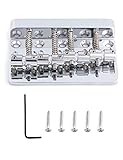
Metallor 4 String Bass Bridge Tailpiece Fixed Saddles for Electric Bass Guitar Jazz Bass or Precision Bass Chrome.
$12.99
The Metallor bridge offers versatile string loading options and fully adjustable barrel saddles, making it a robust and adaptable upgrade for many 4-string basses.
View on Amazon
OVSAL Chrome Electric Bass Guitar Bridge with Brass Saddles Zinc Alloy Plate 4 String Fixed Bridge Compatible with Fender Jazz Precision Bass Bridge Replacement Parts
$20.99
The OVSAL Chrome bridge provides a reliable, standard replacement with a durable zinc alloy baseplate, suitable for general upgrades without premium investment.
View on Amazon
Fender HiMass 4-String Bass Bridge Assembly with Brass Saddles - Chrome
$52.74
The Fender HiMass bridge, with its brass machined saddles and baseplate, is designed to deliver superior sustain and tonal clarity, catering to discerning players.
View on Amazon
- Bridge Size (L x W): Approx. 80 x 56 mm(3.15 x 2.2 in); String Spacing: 19 mm(0.75 in); E to E String Spread: Approx. 56 mm(2.2 in).
- Compensated with 4 stringed Jazz bass replacement parts, also can be a decoration of your bass.
- Material: Zinc alloy baseplate, cnc machined brass saddles. Durable to use and easy to install.
- Features fully adjustable saddles (for intonation and height level). High mass bridge design for an easy install & easy access.

- Fender High Mass 4-String Bass Bridge Assembly with Zinc Saddles
- HiMass Bridge Design Adds Sustain, Resonance, and Improved Attack – Zinc saddles with string notches impart thick, round tone while enhancing low-end response without significantly altering your bass's character
- Zinc Saddles and Bridge Plate with .75" String Spacing – Premium construction ensures optimal string vibration transfer and comfortable finger placement for any playing technique
- Direct Drop-In Replacement for Vintage-Style Fender 4-String Bass – Five-screw mounting system; includes .050 saddle height hex wrench for easy setup (mounting hardware not included)

- High Mass Bass Bridge
- Black Finish
- Retrofits 5-hole Fender

- HiMass bass bridge
- .75" string spacing
- Brass machined saddles and baseplate
- 4-screw mounting

- Package Dimensions: 1.016 H x 10.414 L x 5.588 W (centimeters)
- High Quality
- Package Weight: 0.022 pounds
- Country of Origin : United States

- 4 string bass guitar bridge.
- String Space: 19mm(0.75 inches).
- Direct replacement for a traditional 4 stringed Jazz bass or similar precision instruments.
- Good DIY parts for guitarists or luthiers.

- Replacement bridge for traditional F-style PB or JB bass bridge, please check its size before you buy
- 5 mounting screw holes spaced 17.5mm (11/16 inch) apart, totally 70mm (2-3/4 inch). String spacing is 19mm (3/4 inch), totally 57mm (2-1/4 inch)
- Heavy duty zinc alloy made plate with steel saddle
- Top-Loading, string through-bridge design

- Ideal for PB/JB style bass
- String spacing: 57mm (2-1/4 inch)
- Material: Brass metal
- Screws and springs are included

- GB406 Bridge Dimensions (L × H): Approx. 82.5 mm × 63.5 mm; string spacing adjustable from 17 mm to 19 mm. Please confirm all dimensions before placing your order.
- Construction: Made of premium metal, it boasts outstanding durability and stable long-term performance for electric bass guitars.
- Complete 4-string bass bridge assembly with roller saddles.
- Ideal for new builds, instrument upgrades or worn bridge replacements.

- Material: brass roller and zinc alloy saddle, good texture with fine workmanship, solid and durable to use.
- This bass bridge features roller saddles that effectively minimize string breakage while maintaining precise intonation and tuning stability.
- Adjustable string spacing from a narrow 17mm to a wide 19mm and anywhere in between.
- It offers 3-dimensional adjustment for string height, intonation, and string spacing (with roller saddles).
This article is part of our complete guide Music & Instruments — browse all our comparisons and buying guides.
Last update on 2026-10-15 / Affiliate links / Images from Amazon Product Advertising API
How to Choose the Best Bass Guitar Bridges Bridge Parts
Material and Construction
The material composition of a bass bridge significantly influences its durability, sustain, and tonal characteristics. Heavy-duty cast base assemblies, like those found in the Metallor bridge, typically offer robust stability and efficient vibration transfer. For players prioritizing enhanced sustain and a warmer tonal quality, bridges featuring brass machined saddles and baseplates, such as the Fender HiMass assembly, are often preferred. Conversely, options with a zinc alloy baseplate, like the OVSAL bridge, provide a cost-effective and durable solution that still performs reliably for many standard applications. The choice of material in practice dictates how much resonance is transferred to the instrument's body.
String Loading and Saddle Design
How strings are anchored can impact both playability and tone. Many bridges offer dual string loading options, allowing for either top-load or string-through-body configurations, as seen with the Metallor and JD.Moon bridges. String-through-body designs are often reported by users to provide increased sustain and improved string tension. Saddle design also plays a crucial role: barrel saddles (found on Metallor) are common and effective, while brass machined saddles (Fender) are often chosen for their tonal properties. The JD.Moon bridge features roller saddles, which are specifically designed to prevent string wear and tear, potentially extending string life and improving tuning stability by reducing friction.
Compatibility and String Spacing
Ensuring the bridge matches your specific bass model and setup is paramount. Most 4-string bass bridges are designed with a standard string spacing, commonly 19mm (or 0.75 inches), which is essential for proper alignment with the fretboard and pickups. Products like the OVSAL and Fender bridges explicitly state this 19mm spacing, indicating broad compatibility with traditional 4-string Jazz Bass and Precision Bass models. It is vital to measure your existing bridge's baseplate dimensions and string spread to ensure a seamless upgrade or replacement. Mismatched dimensions can lead to installation difficulties or compromised playability.
Pros & Cons
Metallor 4 String Bass Bridge Tailpiece Fixed Saddles for Electric Bass Guitar Jazz Bass or Precision Bass Chrome.
Pros
- Offers versatile top-load or string-through-body stringing options, catering to different player preferences.
- Features heavy-duty cast base assembly for robust construction and improved vibration transfer.
- Includes four fully adjustable barrel saddles, allowing precise intonation and height adjustments.
Cons
- The generic branding might imply less premium materials compared to established brands.
- Barrel saddles, while effective, may not offer the same string longevity as roller saddle designs.
OVSAL Chrome Electric Bass Guitar Bridge with Brass Saddles Zinc Alloy Plate 4 String Fixed Bridge Compatible with Fender Jazz Precision Bass Bridge Replacement Parts
Pros
- Designed as a direct replacement part for traditional 4-string Jazz and Precision bass bridges.
- Constructed with a high-quality zinc alloy baseplate, providing a durable and reliable foundation.
- Maintains a standard 19mm string spacing, ensuring compatibility with many common bass necks.
Cons
- Limited to a top-load stringing method, which might not suit all players' sustain preferences.
- Zinc alloy material, while robust, typically offers different tonal characteristics than brass.
Fender HiMass 4-String Bass Bridge Assembly with Brass Saddles - Chrome
Pros
- Features a HiMass design, which users report contributes to enhanced sustain and improved tone.
- Equipped with brass machined saddles and baseplate, often favored for their tonal warmth and resonance.
- Genuine Fender component, ensuring quality control and precise fitment for compatible instruments.
Cons
- Its HiMass construction makes it heavier than many standard bridges, potentially altering instrument balance.
- The premium materials and branding typically position it at a higher price point than generic alternatives.
Common Mistakes to Avoid
Overlooking String Spacing Specifications
A common pitfall for bassists is failing to verify the string spacing of a new bridge. Products like the OVSAL and Fender HiMass bridges specify a 19mm (0.75-inch) string spacing. Installing a bridge with incorrect spacing can lead to strings not aligning properly with pole pieces on pickups or crowding at the edges of the fretboard, significantly impacting playability and tone.
Ignoring String Loading Method Compatibility
Users often overlook whether a bridge supports their preferred stringing method or their bass's body design. Some bridges, like the Metallor and JD.Moon options, offer both top-load and string-through-body capabilities, providing versatility. However, if a bass is drilled for string-through-body and a top-load-only bridge (like the OVSAL) is chosen, the string-through feature cannot be utilized, potentially affecting sustain or the desired feel.
Underestimating the Impact of Material Choice
The baseplate and saddle material significantly affect the instrument's overall resonance and sustain. Opting for a bridge with a zinc alloy baseplate, as seen in the OVSAL, when a player desires the specific tonal qualities and sustain often associated with brass machined saddles and baseplates (like the Fender HiMass), can result in dissatisfaction with the instrument's updated sound profile.