Funny Tests Trivia for Kids offers an engaging way for children to test their knowledge and learn new facts, ideal for family game nights, educational enrichment, or even long car rides. These products typically focus on making learning enjoyable and interactive for various age groups. Products were evaluated based on content variety, age appropriateness, game mechanics, user reviews, and feature analysis.
Top picks
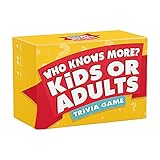
Who Knows More? Kids or Adults, The Ultimate Trivia Game for Kids, Teens and Adults - A Fun Family Party Game
This product offers broad appeal with 'Kids Versus Adults' gameplay and diverse 'Fun Topics for Everyone', ensuring wide family engagement.
View on Amazon
Board Games for Kids 8-12 and Family - Science Trivia Card Game for Kids Age 12+ - Who Knows Chemistry Physics Astronomy Better? - 500+ Questions - Fast-Paced Educational Game for Teens and Adults
Specializing in 'Science Trivia' with over 500 questions for ages 12+, this product offers a deeper, more focused educational experience.
View on Amazon


- INTERACTIVE FUN: Contains 2 colorful buzzers (green,blue), perfect for family activities and group games. Each buzzer lights up and makes a unique sound (Charge,Laser), adding fun and clear identification to each player's answer.
- EDUCATIONAL TOOL: Buzzers can help children exercise their brains and improve concentration. Great for learning, quizzes and games in the classroom, liven up the classroom atmosphere and strengthen communication with students.
- EASY TO USE: Simply install the batteries and press the top of the buzzer to activate the lights and sounds, convenient to use, suitable for adults, teachers and Kids. Each button requires two AAA batteries (need to be purchased separately). Please note...
- ULTRA-PORTABLE DESIGN: 50% smaller than standard buzzers (5 x 4.5 x 3.8 inches) + 4.0 ounces lighter - fits in a teacher's desk drawer or party favor bag. Carrying case included.


- Compete and test your Bible knowledge with this fun and engaging Christian trivia game.
- Play with as many teams as you'd like - perfect for families, friends or even larger church groups. (2+ Players)
- Includes a variety of engaging trivia categories and action cards that keeps the game exciting.
- With 300 cards and over 500 questions, you can replay again and again.

This article is part of our complete guide Computer Software — browse all our comparisons and buying guides.
Last update on 2026-11-11 / Affiliate links / Images from Amazon Product Advertising API
How to Choose the Best Funny Tests Trivia for Kids
Age Appropriateness and Engagement Mechanics
When selecting 'Funny Tests Trivia for Kids', understanding the target age range is paramount. Products like "Who Knows More? Kids or Adults" are designed for broad family participation, featuring simple gameplay where teams collect points by answering questions. In contrast, "Board Games for Kids 8-12 and Family - Science Trivia Card Game" by QUOKKA explicitly targets ages 12+, indicating a higher complexity level and specialized content. Users report that simpler question formats and clear scoring, as seen in "Who Knows More?", tend to maintain engagement for younger participants, while older kids appreciate the challenge of more intricate trivia.
Topic Breadth Versus Specialization
The range of topics covered significantly influences a product's appeal. General knowledge trivia, such as that found in "The Great American Trivia Quiz Book" or "Trivia for Smart Kids (Part 2)", offers a wide array of subjects from animals to history, providing varied learning opportunities. However, for children with specific interests, a specialized game like QUOKKA's "Science Trivia Card Game" can be more deeply engaging. Products like "? WORD TEASERS Test Your Knowledge" aim for 'Random Knowledge', which can be appealing for its unpredictable nature, fostering curiosity across many subjects without diving too deep into one.
Game Format and Player Interaction
The physical format and how players interact with the trivia content are crucial considerations. A traditional quiz book, like "The Great American Trivia Quiz Book", offers a solitary or parent-led experience, focusing on question recall. Card games, such as those from QUOKKA or ? WORD TEASERS, typically encourage more direct interaction, turn-taking, and discussion. "Who Knows More? Kids or Adults" specifically promotes team-based play, which can enhance collaborative skills and competitive fun. The format often dictates portability and ease of setup, with card games generally being more convenient for travel or quick play sessions.
Educational Focus and Learning Outcomes
While all trivia games for kids offer some educational value, the explicit learning focus varies. Some products, like "Trivia for Smart Kids (Part 2)", aim to broadly expand general knowledge across diverse subjects. Others, such as QUOKKA's "Science Trivia Card Game", are intentionally designed to reinforce specific academic subjects, providing a structured learning experience through play. Users often observe that games with clear educational objectives, when presented engagingly, can significantly boost a child's understanding and retention of specific facts, transforming passive learning into an active, enjoyable challenge.
Pros & Cons
Who Knows More? Kids or Adults, The Ultimate Trivia Game for Kids, Teens and Adults - A Fun Family Party Game
Pros
- Facilitates team play, fostering collaboration and competitive fun between kids and adults.
- Covers a diverse range of 'Fun Topics for Everyone', ensuring broad appeal and varied learning.
- Features 'easy to play' mechanics, making it accessible for different age groups to join quickly.
Cons
- The 'Kids Versus Adults' dynamic might sometimes lead to uneven competition if age gaps are too wide.
- Relies heavily on general knowledge, which might not appeal to children with very specific interests.
Board Games for Kids 8-12 and Family - Science Trivia Card Game for Kids Age 12+ - Who Knows Chemistry Physics Astronomy Better? - 500+ Questions - Fast-Paced Educational Game for Teens and Adults
Pros
- Deep dive into science topics (Chemistry, Physics, Astronomy) with over 500 questions, offering substantial educational depth.
- Specifically designed for ages 12+, providing appropriate challenge and content for older children.
- Emphasizes both fun and educational value, making learning engaging for specific STEM interests.
Cons
- Its specialized science focus may limit appeal for children who prefer broader or different subject matter.
- The age recommendation of 12+ means it might be too challenging or less engaging for younger players in a family setting.
B0CGVXGPQG
Pros
- Promotes 'Random Knowledge', which can spark curiosity across unexpected topics and facts.
- Designed as a 'Family Friendly' card game, encouraging interaction and conversation without screens.
- Portable 'Car Trivia Game' format makes it suitable for travel and on-the-go entertainment.
Cons
- The 'Random Knowledge' approach may lack the structured learning or thematic depth of more specialized trivia.
- With 150 cards, the replay value might be perceived as lower compared to games with hundreds more questions or expansion packs.
Common Mistakes to Avoid
Overlooking Age-Specific Content
A common mistake is selecting a trivia product without carefully reviewing its intended age range. For instance, opting for QUOKKA's "Science Trivia Card Game for Kids Age 12+" for a group of 8-year-olds can lead to frustration due to overly complex questions. Conversely, a product designed for younger children, like those focused on ages 3-5, might bore older kids who require more challenge.
Prioritizing Breadth Over Specific Interests
Purchasers sometimes choose general knowledge books, such as "The Great American Trivia Quiz Book", when a child has a strong, specific interest. If a child is passionate about animals, a specialized deck like "? WORD TEASERS About Dogs" or 'Little Known Truths Zoo Animal Trivia Flash Cards' would provide a more engaging and enriching experience, deepening their knowledge in a beloved subject rather than offering a superficial overview of many.
Ignoring Game Format and Interaction Style
Another frequent oversight involves neglecting the game's format and how it facilitates interaction. A trivia book, like "Trivia for Smart Kids (Part 2)", is primarily a solo or parent-led activity. If the goal is interactive family engagement, a card game that encourages team play or turn-taking, such as "Who Knows More? Kids or Adults", would be a more suitable choice. The physical mechanics, like collecting points or quick-fire rounds, significantly impact group dynamics and sustained interest.
Misjudging Educational Depth and Replayability
Failing to consider the balance between pure fun and educational depth, as well as replayability, is a mistake. Some trivia games, while fun initially, might have a limited number of unique questions, leading to quick exhaustion of content. Products like QUOKKA's game with "500+ Questions" offer substantial content, implying greater longevity and repeated learning opportunities compared to simpler sets with fewer cards, ensuring continued engagement over time.